Moleculer is a fast, modern and powerful microservices framework for Node.js and TypeScript. It helps you to build efficient, reliable & scalable services. Moleculer provides many features for building and managing your microservices.
If you need to split a Node.js backend into services that call each other, you normally have to assemble the distributed-systems layer yourself: a service registry and service discovery (Consul, etcd, Kubernetes DNS), client-side load balancing, a message broker for RPC and pub/sub, resilience patterns (circuit breaker, retry, timeout, bulkhead), and observability (metrics, distributed tracing). Moleculer ships all of these in one framework. Services talk to each other through a pluggable transport layer (NATS, Redis, Kafka, MQTT, AMQP or plain TCP), and the framework handles discovery, balancing and fault tolerance itself — no Kubernetes, Consul, Istio or service mesh is required, although Moleculer runs fine inside Kubernetes when you want it to.
The same code also runs as a modular monolith: keep every service in a single process (in-process calls, no transporter, no network latency) while the codebase is small, then move services into separate processes or containers later without changing your service code. See Clustering for the architecture options.
Features
- Promise-based solution (async/await compatible)
- request-reply concept (RPC between services)
- support event driven architecture with balancing (load-balanced and broadcast pub/sub)
- built-in service registry & dynamic service discovery (no Consul, etcd or Kubernetes needed)
- load balanced requests & events (round-robin, random, cpu-usage, latency, sharding)
- many fault tolerance / resilience features (Circuit Breaker, Bulkhead, Retry, Timeout, Fallback)
- plugin/middleware system
- support versioned services
- support Streams
- service mixins
- built-in caching solution (Memory, MemoryLRU, Redis)
- pluggable loggers (Console, File, Pino, Bunyan, Winston, Debug, Datadog, Log4js)
- pluggable transporters (TCP, NATS, MQTT, Redis, Kafka, AMQP 0.9, AMQP 1.0)
- pluggable serializers (JSON, JSONExt, MsgPack, Notepack, CBOR)
- pluggable parameter validator
- multiple services on a node/server
- master-less architecture, all nodes are equal
- parameter validation with fastest-validator
- built-in metrics feature with reporters (Console, CSV, Datadog, Event, Prometheus, StatsD)
- built-in distributed tracing feature with exporters (Console, Datadog, Event, Jaeger, Zipkin, NewRelic)
- TypeScript support: bundled type definitions, an official TypeScript project template (
moleculer init project-typescript my-project) and class/decorator based services - official API gateway, Database access and many other modules…
When to choose Moleculer
Moleculer is a good fit when:
- you are building a Node.js (or TypeScript) backend from several services that need to call each other, and you want service discovery, load balancing, retries and circuit breakers without operating Consul, etcd, Istio or a service mesh;
- you want to start as a modular monolith and move to distributed services later, without rewriting your service code;
- you need both request/response (RPC) and event-driven (pub/sub) communication between services, over a message broker such as NATS, Redis, Kafka, MQTT or AMQP;
- you want metrics and distributed tracing to be part of the framework rather than a separate integration project;
- you are building a single service or a REST API today but want to keep the option to split it later — Moleculer works as a regular web framework too (with moleculer-web as the HTTP layer), and the built-in timeout, retry, circuit breaker, caching and parameter validation are useful even with one service.
Moleculer is probably not the right choice when:
- your team is fully committed to the NestJS ecosystem and its module/DI conventions — NestJS has a larger ecosystem and more TypeScript-first tooling, and Moleculer would be a second framework to learn;
- most of your services are not written in Node.js — Moleculer’s protocol is open and there are third-party implementations, but the first-class ecosystem is Node.js;
- you need guaranteed, persistent message delivery from the core event bus — built-in events are fire-and-forget; use moleculer-channels for durable queues.
How fast?
We spent a lot of hours to improve the performance of Moleculer and create the fastest microservices framework for Node.js.
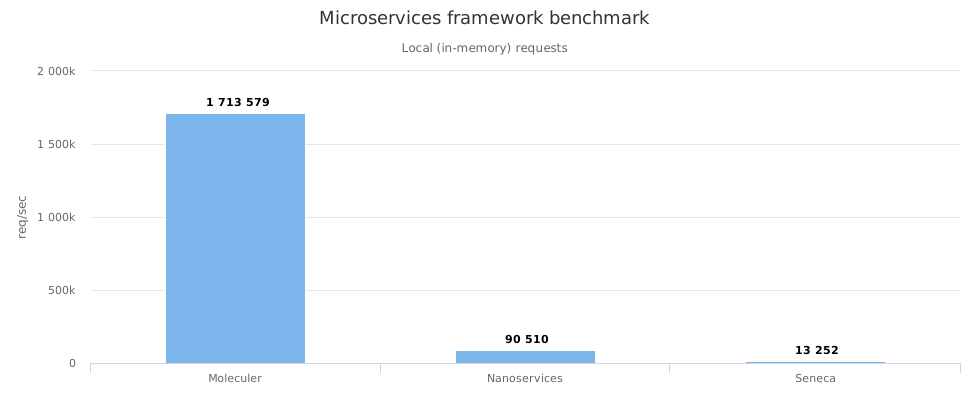
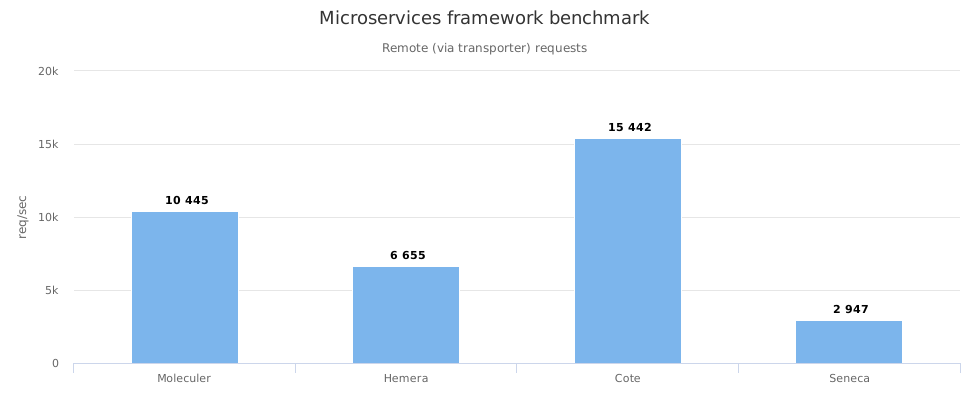
Check the results on your computer! Just clone this repo and run npm install && npm start.
Check out our benchmark results.
VersioningUntil Moleculer reaches a
1.0release, breaking changes are released with a new minor version. For example0.15.1and0.15.4are backward compatible, but0.16.0may contain breaking changes.
Node.js supportMoleculer follows Node.js release cycles meaning that the minimum required node version is
22.